Neo Deco pendant lighting will instantly transform your living room into a refined, architecturally striking space.
Home decor has many elements, and lightning is definitely important.
In this guide, expect to learn more about statement lamps, layering lightning with wall art, as well as balancing brass with geometry.
So, if you’re looking to light up your living room, keep reading.
Neo Deco Pendant Lighting
If you keep up with trends, you know that Art Deco is rearing its modern head once again.
And that is especially for living rooms and wall art.
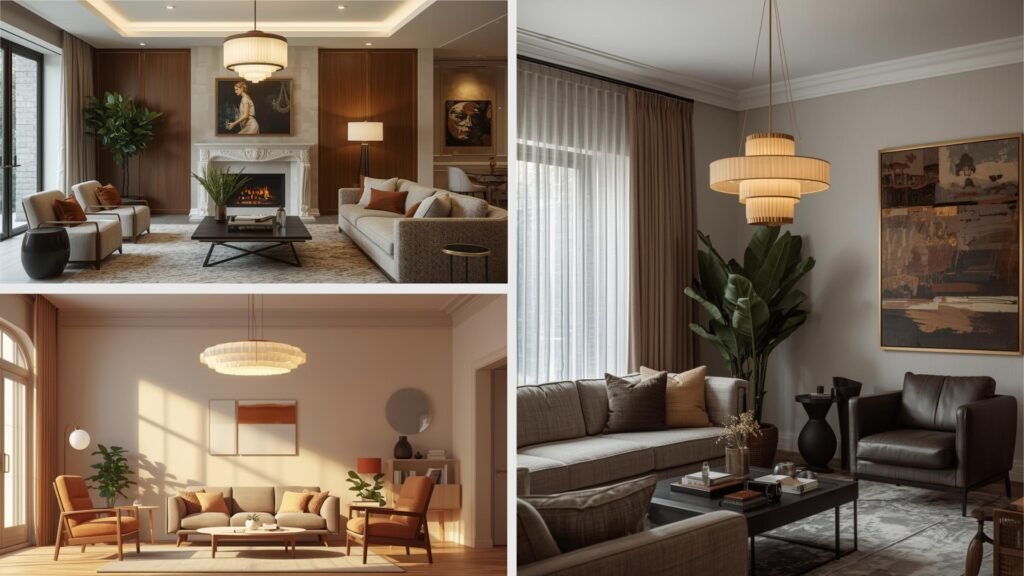
Neo Deco pendant lighting, therefore, is a way to mix the glamour and geometry of Art Deco with modern minimalism.
Its main features include sculptural shapes, stepped forms, arches, and fan-inspired details.
For example, you will see that in many cases it leads to finished in brass, glass, or matte black.
Unlike traditional Deco, Neo Deco is cleaner and more restrained. The focus is on proportion and negative space.
So, these ceiling fixtures act as both illumination and statement pieces.
It does that by adding architectural structure and refined elegance to contemporary living rooms without overwhelming the design.
In our case, the following sections will focus on statement lamps, layering lightning with wall art, and balancing brass with geometry.
Statement Pendant Lamps
Neo Deco pendant lighting almost always requires something that stands out.
That’s because Neo Deco interiors thrive on drama, symmetry, and sculptural presence, and nothing captures that spirit faster than a bold pendant lamp.
For instance, think faceted glass shades, tiered silhouettes, and strong vertical drops that command attention from the center of the room.
A statement pendant is as functional art, drawing the eye upward and giving architectural weight to even the simplest layout.
Look for fixtures that echo classic Art Deco geometry. For instance, sunbursts, stepped forms, and elongated cones.
Of course, scale matters. A large pendant in a room with high ceilings may anchor seating arrangements, while a cluster of smaller pendants may create rhythm over a coffee table.
The key is contrast.
When the surrounding furnishings are streamlined and neutral, a sculptural pendant is a defining feature.
For instance, it may cast layered shadows that shift throughout the day and turning ambient light into a design element rather than just illumination.
Layered Lighting with Wall Art
Neo Deco pendant lighting is not about a single light source; it’s about composition, and trendy wall art fits.
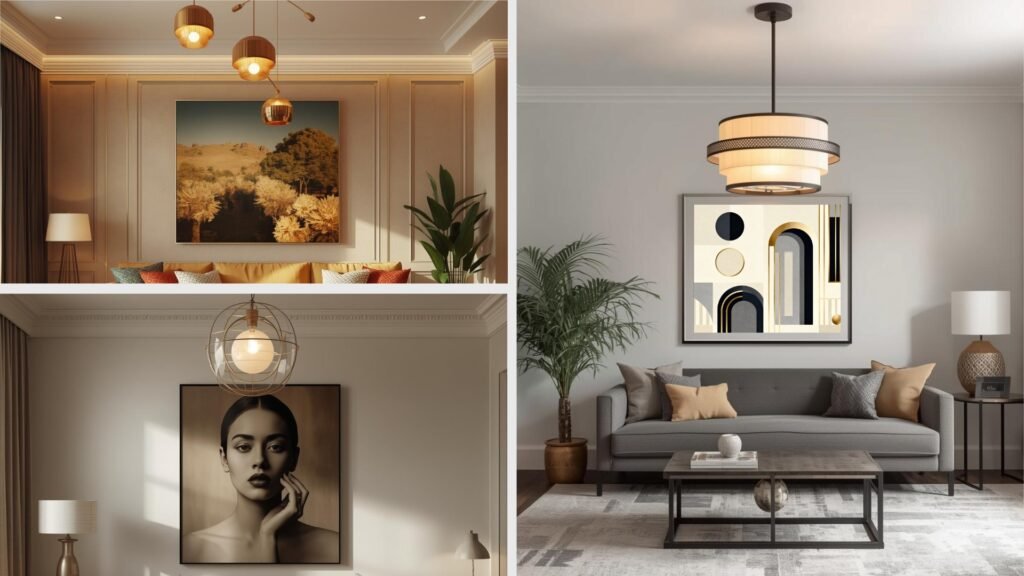
Pairing pendant lighting with thoughtfully placed wall art amplifies both.
A geometric pendant above complements structured prints or fan-motif artwork positioned at eye level.
For example, it creates a vertical dialogue between ceiling and wall.
Warm-toned lighting brings out the best in metallic details within framed pieces, especially when brass or gold accents are present.
Consider adding subtle wall sconces to frame artwork and reinforce symmetry. This is a hallmark of Deco-inspired spaces.
And the pendant provides the glow, while the art reflects and distributes that light in a controlled, intentional way.
Even mirrors with arched tops will interact beautifully with overhead fixtures. And that is all about multiplying their visual impact.
That is, layering prevents harsh lighting and instead builds dimension.
You create depth that feels curated and architectural rather than flat or incidental by allowing light to bounce across textures.
Balancing Brass and Geometry
Brass is almost synonymous with Deco influence, but Neo Deco demands restraint and precision.
The goal is balance, not excess.
A pendant with brass detailing will introduce warmth, yet it should harmonize with the geometry already present in the room.
For example, repetition is powerful. If the light fixture features angular lines, echo those shapes in coffee tables, shelving, or patterned rugs.
On the other hand, if the pendant incorporates circular tiers, introduce subtle curved elements elsewhere to soften the structure.
Mixing finishes, such as brass with smoked glass or marble, prevents the space from feeling overly ornate.
Proportion also plays a role with Neo Deco pendant lighting.
For instance, geometric forms feel refined when they are spaced thoughtfully and not competing for dominance.
That is, you achieve a cohesive aesthetic that feels deliberate by coordinating metallic tones with clean lines and symmetrical arrangements.
In my opinion, the result is a living room that feels elevated through clarity and contrast.
Basically, you’re going for a space where every angle and reflection works together to express modern glamour.
Neo Deco Pendant Lighting Checklist
Neo Deco pendant lighting transforms a living room through sculptural form, layered illumination, and intentional geometry.
By choosing a bold statement fixture, coordinating it with structured artwork, and balancing brass with clean lines, you create depth and architectural presence.
Light is definitely more than function. If you do it right, it shapes mood, highlights symmetry, and refines proportion.
So, with thoughtful placement and repetition of forms, your space feels cohesive, elevated, and distinctly modern while honoring Deco-inspired elegance.
Looking for more home decor ideas? Follow me on Pinterest.