

Art deco fan wall art is a popular segment of this modern style, and here is a guide to help you choose them for your space.
Home decor requires thinking outside the box. The fan’s geometric elegance, cultural sophistication, and symbolic optimism gives you a lot.
In this guide, we will visit eight works that explore the fan as a unifying modern Deco language.
As you will see, the fan integrates into modern interiors as a subtle structural element. It adds rhythm, clarity, and softness without imposing a specific style.
So, if you are looking into this, keep reading.
Art Deco Fan Wall Art
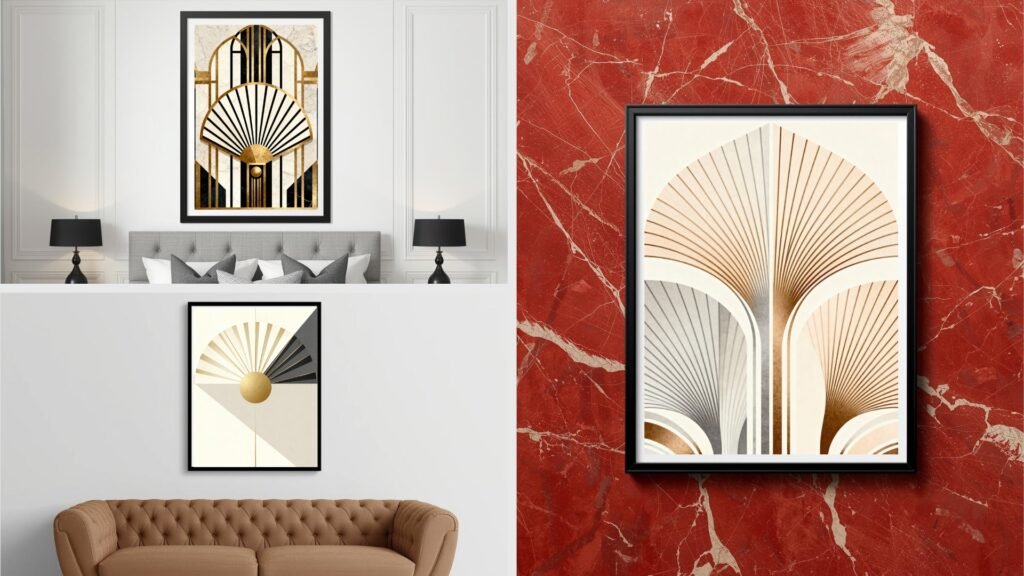
From our wall art collection that focuses on Art Deco, there are eight fan pieces in total.
They are Modern Deco Fan Arch, Deco Fan Lines in Motion, Minimal Deco Fan Trio, Deco Fan + Circle Dialogue, Deco Fan Shadow Study, Deco Vertical Fan Panels, and Deco Fan Triptych Core.
The fan logic is first introduced and then expanded across these works.
Across the collection, the fan acts as a unifying architectural language rather than a decorative flourish.
It references classic Art Deco symbolism, such as order, optimism, upward movement.
Yet, it’s consistently softened, abstracted, or stretched to suit modern interiors.
Sometimes the fan appears as a singular anchoring form, sometimes as repeated panels, linear radiations, or quiet shadows.
That is, these pieces explore the fan as structure, rhythm, and balance.
For instance, expect it to shift from bold focal point to subtle atmospheric presence while keeping a coherent visual identity grounded in modern Deco restraint.
The Fan Connection
The fan became closely tied to Art Deco. For home decor style ideas, it’s perfect.
The fan works with the Art Deco movement’s obsession with geometry, rhythm, and modern elegance.
When Art Deco emerged in the 1920s and 1930s, designers were looking for forms that felt luxurious yet rational, decorative yet disciplined.
The fan offered all of that at once: a clear geometric structure, natural symmetry, and a sense of controlled expansion that could be stylized endlessly.
Culturally, the fan also carried associations of sophistication and cosmopolitan life.
For instance, it referenced Asian decorative arts that heavily influenced early Art Deco, especially Japanese and Chinese folding fans.
Asian fans are still popular in Western culture because of their balance, restraint, and graphic clarity.
At the same time, the fan echoes sunbursts, shells, fountains, and rising light.
Of course, these are symbols of optimism, progress, and energy that resonated strongly in the post–World War I era.
Architecturally and visually, the fan translates beautifully into stepped lines, radiating ribs, and arched segments.
That makes it ideal for façades, metalwork, murals, textiles, and interiors.
In contemporary interpretations, the fan still carries that vibe. It signals Deco instantly, but it also adapts well to minimalism, abstraction, and modern spatial thinking.
For Non-Art Deco Homes
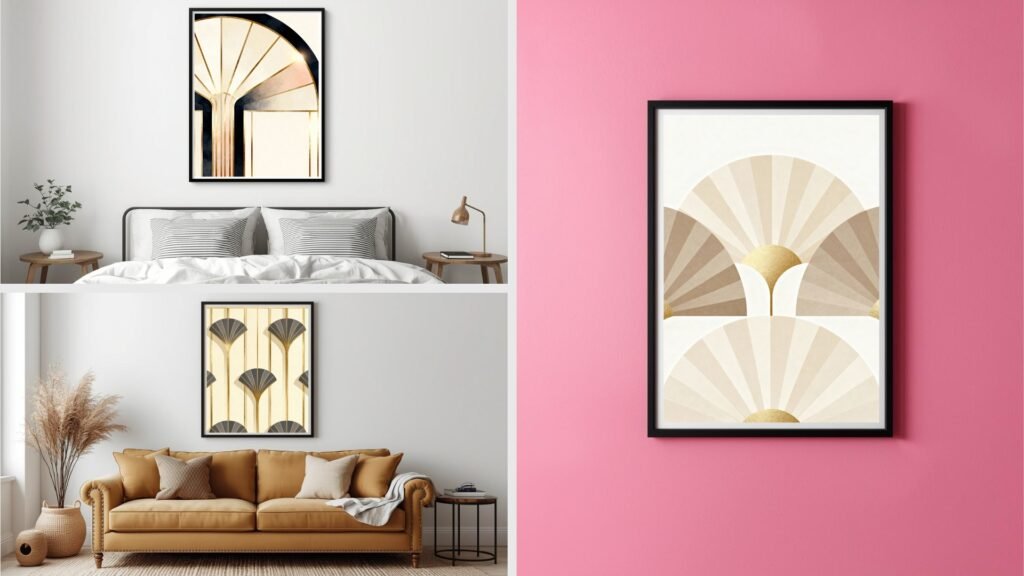
Wall art decor principles tell us we don’t need to fit into a box.
For example, fans integrate perfectly into non–Art Deco homes when they’re used as geometry rather than style.
Instead of signaling a specific era, the fan may be an abstract architectural shape that supports the space.
Choosing pieces with generous negative space, soft edges, and restrained palettes gives the form the chance to read as calm and contemporary.
Neutrals, stone tones, muted metallics, or shadow-based designs prevent the fan from feeling ornamental or retro.
Placement also plays an important role. When positioned where architectural logic already exists—above a sofa, aligned with shelving, centered over a console—the fan is structural.
For example, it’s almost like a visual echo of arches, windows, or doorways.
In modern interiors, I think the fan introduces rhythm and softness.
For example, in organic or minimalist spaces, it adds order and clarity.
The success comes from letting the fan be either a gentle anchor or a subtle accent, giving it the opportunity for its form to enhance the room without defining it stylistically.
Looking for more home decor ideas? Follow me on Pinterest.


Pingback: Trendy Wall Art Guide That Is Actually Insanely Powerful - Bella Rowe
Pingback: Deco Fan Wall Art Print Make Insanely Beautiful Pieces